
If someone has brought up clear aligners for your child, you probably have a pretty straightforward question: is this actually the right move for my kid, and what will it mean for our daily life? Those are exactly the right things to be thinking about.
For a lot of kids, aligners are a great fit. For others, braces or waiting for the right growth window gets a better result. The only way to know for sure is an orthodontic evaluation that looks at how your child's teeth and jaw are developing, what the specific bite issue is, and whether your child is ready to take care of something removable.
Dr. Liu, Dr. Zorc, Dr. Alkhunaizi, and the rest of the team at SuperKids Pediatric Dentistry have this conversation with families every single week. They will walk you through what they see, explain your child's real options, and help you understand what treatment would actually look like day to day. Ready to get started? Contact us and we will find a time that works for your family.
If your child's teeth are coming in crooked, it's usually not something you caused. A child's mouth is constantly changing. Jaws grow at their own pace, twenty baby teeth gradually make way for thirty-two permanent ones, and the timing of all that doesn't always go smoothly.
Tooth size and jaw size are both inherited, and they don't always match up perfectly. A child might inherit a narrow upper jaw from one parent and larger teeth from the other, and that combination leads to crowding no matter how well they brush. Things like underbites, deep bites, and small chins also tend to run in families. Permanent teeth generally come in a predictable order, but not always. A tooth that arrives early can take up space meant for the one next to it, and a tooth that arrives late may find that space already gone.
Baby teeth do more than just help your child chew. They hold space for the permanent teeth coming in underneath. When a baby tooth is lost too early because of decay or an injury, the neighboring teeth can shift into that gap and leave no room for the permanent tooth. That's one of the reasons we take cavities in baby teeth seriously, and why we include tooth eruption management and space maintainers in our care. Habits like thumb sucking or pacifier use past infancy can also push the upper front teeth forward, narrow the arch, and create what's called an open bite, where the front teeth don't touch when the mouth is closed. Tongue thrusting, which is when a child pushes their tongue forward during swallowing, can have a similar effect over time.
Children who breathe through their mouth most of the time tend to hold their tongue low and keep their lips apart. Over the years, that can actually affect how the upper jaw grows. If you notice your child snoring a lot or consistently breathing with their mouth open, it's worth mentioning to both your pediatrician and your child's dental team. In some cases, a restricted tongue attachment, sometimes called a tongue-tie, can affect how the tongue rests and how teeth space out. It's something we look for during your child's visit.

You don't need to figure this out on your own. You just need to notice something and bring it up. The American Association of Orthodontists recommends a first orthodontic check-up around age seven. By then, the front permanent teeth and first molars have usually come in, and a dentist can get a clear picture of how the bite is developing while the jaws are still young enough to guide.
Here are some things parents commonly notice at home:
Getting an early screening does not mean your child will start treatment right away. Most seven-year-olds who come in are simply checked on every year or so while they grow. The goal is to catch the smaller number of issues that become harder to correct once growth slows down.
One of the most common questions parents ask is: which is better, aligners or braces? The honest answer is that it depends on your child. Each option has real advantages, and the right fit comes down to their bite, their personality, and your family's day-to-day life. Here is how they compare.
Aligners are nearly invisible, which matters a lot to kids who are already self-conscious about their smile. Clear or ceramic braces are a more subtle option too. And honestly, plenty of kids love picking colored bands for their metal braces and treat it as a way to show some personality.
Aligners do not have any wires or brackets, so there is nothing to poke or scrape the inside of the cheek. Each new set of trays can cause a day or two of pressure while teeth adjust, but most kids get used to it quickly. Braces tend to cause more irritation in the first week and after each adjustment visit, and families usually keep dental wax on hand for comfort.
With aligners, your child simply takes them out to brush and floss as usual. Braces are fixed in place, so food and plaque can collect around the brackets. Kids with braces need to use floss threaders or a water flosser to clean properly, which is why regular cleanings and preventive care become even more important during treatment.
Aligners come out at mealtimes, so your child can eat whatever they like. With braces, some foods are off the table for the whole treatment, including popcorn, hard candy, chewy caramels, whole apples, corn on the cob, ice, and gum. For some kids this is no big deal; for others it is a real consideration.
Both options require check-ins every few weeks. Aligner visits are usually quick since we are just confirming everything is on track and handing over the next set of trays. Braces visits take a little longer because wires need to be adjusted. Our orthodontists and pediatric dentists will put together a visit schedule that works for your family.
With braces, a loose bracket or a poking wire can mean an unplanned trip to the office. With aligners, a lost or cracked tray is usually handled by switching to a replacement or moving ahead to the next set. Neither situation is a crisis, but it is good to know what to expect.
This is one of the biggest practical differences. Braces are bonded to the teeth, so they work regardless of whether your child is enthusiastic about treatment. Aligners only work when they are actually being worn. If your child tends to forget things or is resistant to the whole idea, braces will often get the job done faster and more reliably.
For contact sports, aligners come out and a regular mouthguard goes in. Kids with braces need a special orthodontic mouthguard that fits over the brackets. If your child plays a wind instrument, aligners may require a short adjustment period, and braces can too, though most kids adapt within a few weeks.
Two children with very similar-looking crowding can walk out with completely different recommendations. The reason almost always comes down to where they are in their growth.
Some issues are genuinely easier to fix while the jaw is still growing. A narrow upper jaw causing a crossbite, crowding that leaves no room for incoming teeth, a habit pushing teeth out of position, or front teeth that stick out far enough to be at risk in a fall are all situations where acting early can make a real difference.
A short first phase, using something like an expander, a space maintainer, or limited aligner work, helps set the stage so permanent teeth have a better chance of coming in where they should.
This is actually where most kids land. We take records, note what we see, and check back every six to twelve months alongside regular cleanings. Some spacing issues work themselves out as the jaw grows, and jumping in too soon can mean more time in appliances than was ever necessary.
Once most of the permanent teeth have come in, we can address everything together and get the bite where it needs to be.
For a lot of families, this is the only phase of treatment they will ever need, and it is often the most straightforward path.
Starting treatment before the timing is right can add cost and chair time without actually improving the outcome. If waiting a year means a faster, more predictable result, we will say so, and we will tell you exactly what we are keeping an eye on in the meantime.
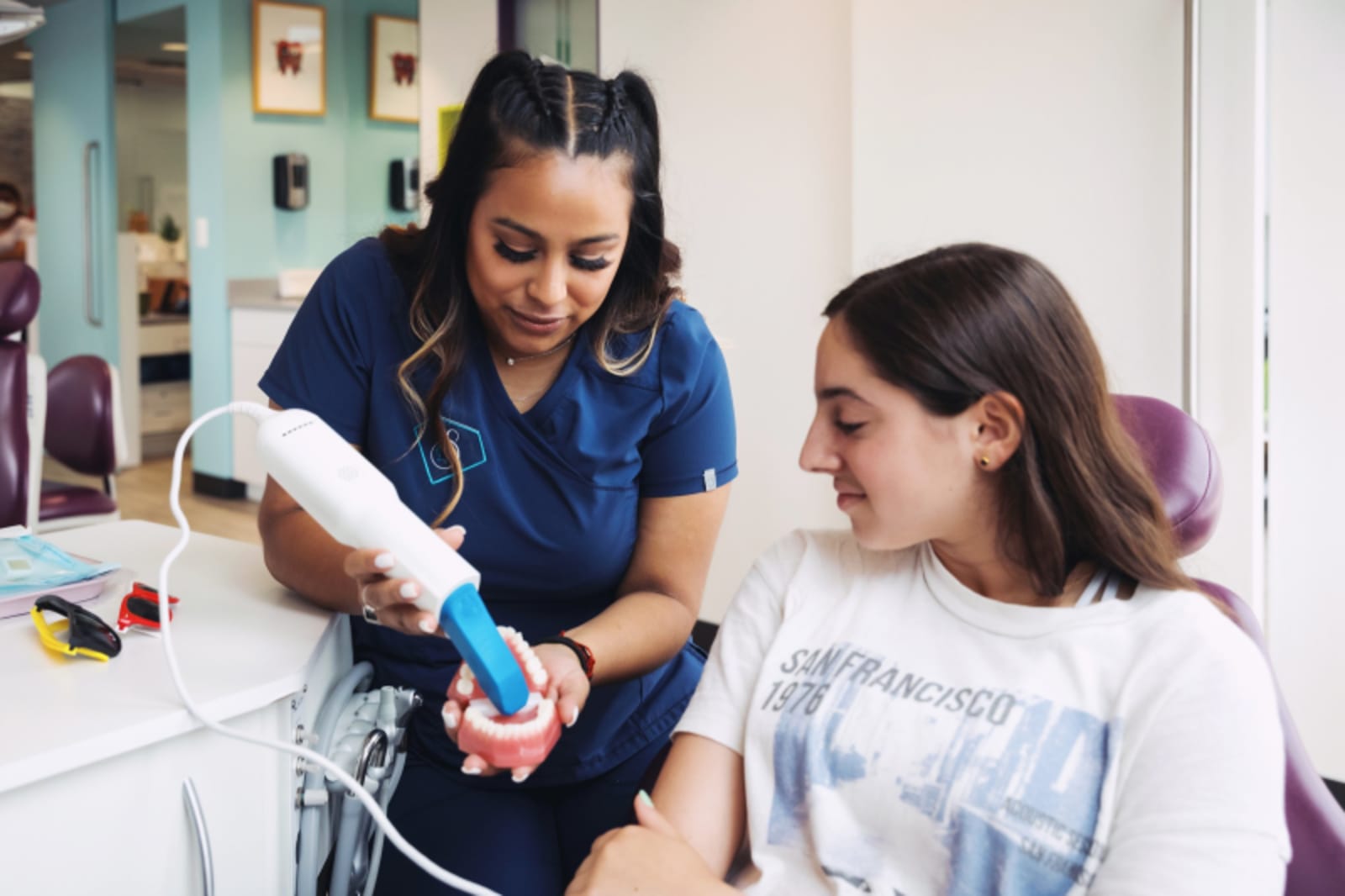
We start by taking an iTero scan, photos, and X-rays. From there, we map out exactly how each tooth needs to move to reach its ideal position. The cool part? Your child gets to see a preview of their projected smile on screen before anything is decided. Most kids think this part is pretty fun.
Once the plan is approved, a full set of custom trays is made. This usually takes a few weeks. If your child needs a cleaning, filling, or sealant before starting, this waiting period is a great time to take care of it. You can see everything we offer on our pediatric dental services page.
At this appointment, we try in the first set of trays and make sure everything fits comfortably. Depending on the plan, we may also place small tooth-colored dots called attachments on certain teeth.
These are totally normal and just give the aligners a little extra grip to do their job. Before your child leaves, we walk them through exactly how to put the trays in, take them out, store them, and keep them clean.
Every one to two weeks, your child moves on to the next set of trays at home. It is a good idea to hold onto the previous set just in case a tray gets lost or damaged.
Every few weeks, your child comes in so we can make sure the teeth are moving the way they should. These visits are usually quick. We check the fit, hand over the next batch of trays, and catch any small issues before they become bigger ones.
Toward the end of treatment, a tooth or two might not have moved exactly as planned. That is completely normal. We take a fresh scan and make a small set of refinement trays to finish the job. This does not mean anything went wrong. It is just part of how the process works.
When the last tray comes out, we take final records and get your child fitted for a retainer right away. This is an important step to make sure the results last.
It depends on how much movement is needed and how consistently your child wears their trays. Most treatment plans are measured in months, not years. We will give you a realistic estimate once the plan is built. The biggest factor in finishing on time? Wearing the trays as directed, ideally around 22 hours a day.

Aligners need to be worn 20 to 22 hours a day to stay on track. That means they come out for meals and brushing, and go right back in. It sounds like a lot, but most kids adjust quickly once it becomes part of the routine. The tricky part is long afternoons of snacking, which can eat into that window faster than you'd expect.
Trays come out for all food and any drink other than plain water. Hot drinks like coffee or tea can warp the plastic, and sugary drinks can get trapped against the teeth while the trays are in. One silver lining: kids who tend to graze throughout the day often naturally shift toward sitting down for actual meals, which is better for their teeth anyway.
After taking the trays out, give them a quick rinse and brush them gently with a soft toothbrush and lukewarm water. Before putting them back in, your child should brush their teeth too. A small travel kit in the backpack, with a toothbrush, toothpaste, and the tray case, makes this easy to manage at school. Our team walks every child through this routine at their visits, the same way we cover brushing and flossing at every preventive visit.
It is normal for teeth to feel a little sore or tight for a day or two when switching to a new set of trays. That is just the aligners doing their job and moving things along. A helpful trick: have your child put in a new set right before bed so they sleep through the most uncomfortable stretch. Most kids barely notice it after the first couple of transitions.
Some kids develop a slight lisp in the first few days while their tongue gets used to the trays. This is completely normal and almost always goes away on its own. Talking, reading aloud, or just having regular conversations helps speed things along.
If a tray gets lost or cracked, have your child put the previous set back in right away and get in touch with us. We will figure out whether to send a replacement or move ahead to the next set. The important thing is not to go days without anything in, since that is what slows progress down.
For school days, the routine is simple: keep the case in the backpack, take trays out at lunch and put them in the case (not a napkin, since that is how they get thrown away), brush or rinse after eating, and pop them back in before heading to class. For contact sports, trays come out and a mouthguard goes in instead. Kids who play wind instruments usually need just a few days to adjust to playing with the trays in.
Orthodontics doesn't replace your child's regular dental care. It runs alongside it, and our team coordinates both so nothing falls through the cracks.
Progress visits are quick. We check that the teeth are moving the way the plan expects, make sure the attachments are still in place, ask honestly how the wear time has been going, and send your child home with the next set of trays. Sometimes teeth move a little differently than expected, and that is completely normal. We might keep your child on the current set a little longer, step back a set, or do a quick rescan to update the plan. The sooner we catch a small shift, the easier it is to correct.
Regular exams and cleanings continue on their usual schedule throughout treatment. Fluoride treatments and sealants are still available too. One thing to keep in mind: aligners make it easier to brush and floss than braces do, but trays are in for up to 22 hours a day.
Anything sitting on the teeth gets sealed in, so brushing thoroughly before putting trays back in really matters. We check in on gum health and grinding at every visit, and we go over hygiene habits as often as needed. If a cavity comes up during treatment, we take care of it right away.
Finishing the last tray is a big milestone, but it is not quite the finish line. Teeth have a natural tendency to drift back toward where they started, especially in the first few months after treatment. For kids and teens who are still growing, the jaw can keep changing too, which means retainers stay part of the picture even after active treatment is done.
There are a few different retainer options. Removable clear retainers look a lot like aligners and are simple to wear and clean. Fixed retainers are thin wires bonded to the back of the front teeth, so there is nothing to remember to put in, though they do need careful flossing. Traditional retainers with a wire and acrylic plate are sturdy and easy to adjust over time.
Our orthodontists will recommend the best fit based on your child's bite, how well they have done with removable appliances, and how much growing they still have ahead. Right after treatment, retainers are worn more often, then gradually scaled back to nights as things settle. We find that kids stick with their retainer much better when they understand why it matters, so we always take the time to explain it in a way that makes sense to them.
Finishing the last tray is a big deal, but it is not quite the finish line. Teeth have a natural tendency to shift back toward where they started, and that happens fastest in the first few months after treatment ends. For kids and teens who are still growing, that tendency sticks around for a while, which is why retainers and space maintainers stay part of the plan long after the aligners are done.
Our orthodontists will recommend the right retainer based on your child's bite, how well they did with a removable appliance, and how much growing they still have ahead of them.
There are a few options: a clear removable retainer that looks a lot like an aligner, a thin wire bonded behind the front teeth that your child never has to think about, or a traditional wire-and-acrylic retainer that is sturdy and easy to adjust. Right after treatment, your child will wear it more often. Over time, most kids step down to just wearing it at night. We find that kids stick with their retainer much better when they understand why it matters, so we always take a few minutes to explain it in a way that makes sense to them.

A straighter smile is great for confidence, but good alignment does a lot more than that. Teeth that are crowded or overlapping are harder to keep clean, which means a higher chance of cavities and gum irritation as your child gets older. A bite that does not come together evenly can also lead to grinding and worn enamel over time. When pediatric dentistry and orthodontics are under one roof, everything works together.
SuperKids Pediatric Dentistry has offices in Alexandria, Potomac, Sterling, Rockville, and Mt. Vernon to serve families across the area. You can explore our full range of pediatric dental and orthodontic services or find the office closest to you.

We can’t wait to meet you! Contact one of our five convenient locations around the DC area.
We are excited to announce the GRAND OPENING of our fifth Superkids office in Mt Vernon, VA. Accepting new patients starting January 16th, 2023!

